Events

Share
Published 18:25 25 Jul 2025 BST
Updated 18:43 25 Jul 2025 BST
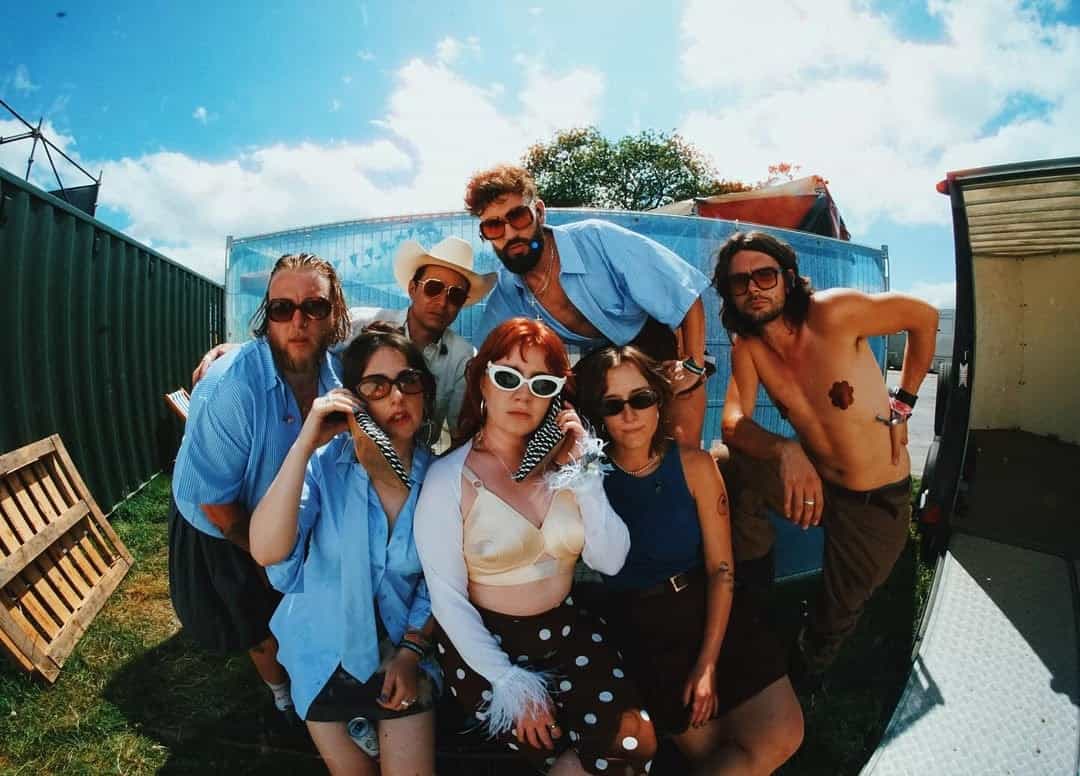
“It was not my decision to have the Irish language edited out of the first-ever play of EURO-COUNTRY on radio,” CMAT said on social media this week.
The lyrics in question are almost comically benign. “Cad is gá dom a dhéanamh mura bhfuil mé ag bualadh leat? / Tá ceann folamh agam, agus peastantach nua / Eirím níos dofheicthe, is tú imithe ó mo shoal / Níl aon rud fágtha sa scátháin / An mbeidh mé álainn mhaol?”
This roughly translates to: “What am I to do if I’m not meeting (personally the context to me feels more like dating) you? / I have an empty head, and a new personality / I become more invisible, you’re gone from my life / There’s nothing left in the mirror / Will I be beautiful bald?”
After we wrote about this alleged censorship for Lovin Ireland the BBC contacted LOVIN directly to inform us that the version of Euro-Country without the Irish language intro was a radio edit provided by CMAT's record label.
Taking to social media later the same day, the Dublin-born-Meath-raised singer, whose full name is Ciara Mary-Alice Thompson, said BBC reps promised her “that they are going to play the Irish language intro, the full version of EURO-COUNTRY tomorrow to make up for it”.
The story is scattered across the archives. The Statutes of Kilkenny in 1366 made speaking Irish illegal in the Plantation of Ulster. Essentially pushing whole Irish-speaking communities off their own land.
The BBC, in its defence, blamed the mysterious "radio version" provided by the record label which CMAT said she never condoned. The contrite BBC promised to play the full version, with the Irish-language opening included.
But to quote our lord and saviour Jojo “it’s just a little too late”. Welcome to the subtle politics of Irishness in Britain.
By the late ’70s, there were cracks in that suppression. BBC’s Tonight aired an interview with the Irish National Liberation Army in 1979.
There is something almost comic about that image now. Adams with a borrowed voice. Every so often this fact resurges again on TikTok or Reels. The actors who played those voices have given interviews. But the effect it had on Irish culture wasn’t funny.
It wasn’t just Northern Ireland the BBC came up against. In 1997, EastEnders went to Dublin. For two episodes, it was all drunken Irishmen, dingy pubs and Catholic priest clichés. Viewers in Ireland revolted. The Irish Embassy complained. The BBC apologized. They admitted the story was “ill‑judged”.
Such moments underline why featuring the Irish language is explicit cultural resistance. This edited song exemplifies how swiftly Britain seems to slip into these historical patterns. The UK embraces Irish artists for international acclaim while simultaneously sanitising, or co-opting, their identities.
To be Irish is to exist, consciously or unconsciously, in opposition to oppression. When Irish artists, like CMAT, take to their social media and call out things like this they continuously remind Britain that genuine cultural appreciation requires reckoning with history rather than editing it for propriety.
Events
Events
Events
Events

Events
Events
For an artist like CMAT to speak Irish publicly or bake it into her art remains inherently political. It is a direct rejection of Britain’s historical attempts at linguistic erasure. For all Irish people speaking even the coupla focal, is a defiant act against oppression and cultural destruction. The Irish language remains a battleground precisely because Britain murdered people for speaking it. Erasure of an Gaeilge was a deliberate, strategic act of cultural warfare.
@sianconway cad é an fhírinne 🤔 #fyp #cmat #gaeilgetiktok #bbc ♬ EURO-COUNTRY - CMAT
The penal-era Administration of Justice (Language) Act of 1737, barred the Irish language from public life, reflecting a deliberate cultural warfare strategy. This enduring mark of empire was only fully repealed earlier this year.
In the 19th century, children learned to fear their own words. A stick called the bata scóir was introduced to classrooms. Children were made to wear a stick tied to a string around their necks. Each time they spoke a word of Irish, a new notch was carved into the wood. By day’s end, the tally of those notches determined how many blows the child would receive. This punishment of children was part of an unbroken philosophy of domination and oppression.
Today, learning and speaking Irish is radical precisely because it still exists. Recently the coupla focal has been growing in popularity. The Irish language now bursts forth defiantly on the world’s stages. It has infiltrated art, social media, your mates, and most dominantly, music. So to have an Irish language intro unceremoniously clipped wounded a people in the midst of reclaiming what has been systemically beaten out of their ancestors.
In the 1960s and 70s, BBC Northern Ireland was run, as former Panorama editor Sir Paul Fox bluntly put it in The Guardian, by “the bloody Protestants”. Catholic voices on housing discrimination, on jobs, on civil rights and all other pertinent issues were smothered. Veteran journalist Martin Bell described it later as a “culture of suppression.”
Then in 1985 Real Lives: At the Edge of the Union aired. The BBC documentary dared to put Sinn Féin’s Martin McGuinness and the DUP’s Gregory Campbell on screen in the same breath. Westminster freaked out. Margaret Thatcher had only a month before “declared that the IRA should be starved of the ‘oxygen of publicity’.” The BBC pulled the programme. BBC journalists, furious at this, staged a one‑day strike. Then came the ban years.
From 1988 to 1994, the British government forbade broadcasters from airing the voices of Sinn Féin leaders. Or anyone associated with republican paramilitaries. Their words had to be dubbed by actors, or subtitled. Gerry Adams would speak and an actor's voice would float out of his mouth like a bad lip‑sync. It was absurd. Critics called it censorship. But the BBC was bound by the law.
2011 brought The Story of Ireland; a five‑part BBC history series that promised depth didn’t deliver it. Irish viewers instead saw a kind of neat revisionism. Famine glossed over, the Penal Laws airbrushed, the Troubles filed down to a set of narratable beats. Reddit called it “revisionist rubbish”. What it was, was systematic erasure of what Britain did to the people of Ireland.
Of course the BBC was under fire earlier this summer for refusing to air the Kneecap set at Glastonbury. The rap trio's Irish-language hip-hop directly challenges British colonial legacies. Their presence at Glastonbury alone triggered political anxiety in Westminster. Instead of livestreaming their performance, like they did every other act, the BBC held it back. They waited for the heat to die down and later released an edited version to iPlayer. A version which stripped of Kneecap’s chants for Palestine and their most pointed anger. By now to many Irish people this is familiar choreography. A dance the BBC has been perfecting for decades.
Despite this, Britain's population have been increasingly fascinated with modern Irish culture. Paul Mescal, Cillian Murphy, Sally Rooney, Fontaines DC, Guinness, Beamish, JW Anderson, Simone Rocha, Sharon Horgan and many more have all charmed British audiences. The Guardian has written about this ‘green wave’, as has The Times, The Observer, The Economist, Time Out, (seemingly every podcast in the UK has covered it) as well as British GQ and Irish writer Naoise Dolan. British people are drinking our drinks and eating Spice Bags. Britain comfortably consumes the black and white aesthetic of Irishness stripped of historical context, yet balks when confronted with the truth of what it means to be Irish.
Our bigger neighbours still struggle with Irish cultural autonomy, reverting to old habits of erasure or commodification.Which brings us back to CMAT, while she’s not accusing the BBC of censorship in regards to the cutting of her melancholic gaeilge, it has echoes of the past baked into it. Sure no one’s going on strike for her song. But it’s just another in a long list of slights against our nation that have by chance happened adjacently to the BBC. However inadvertent and accidental they may be.